Get Started: Asset Management
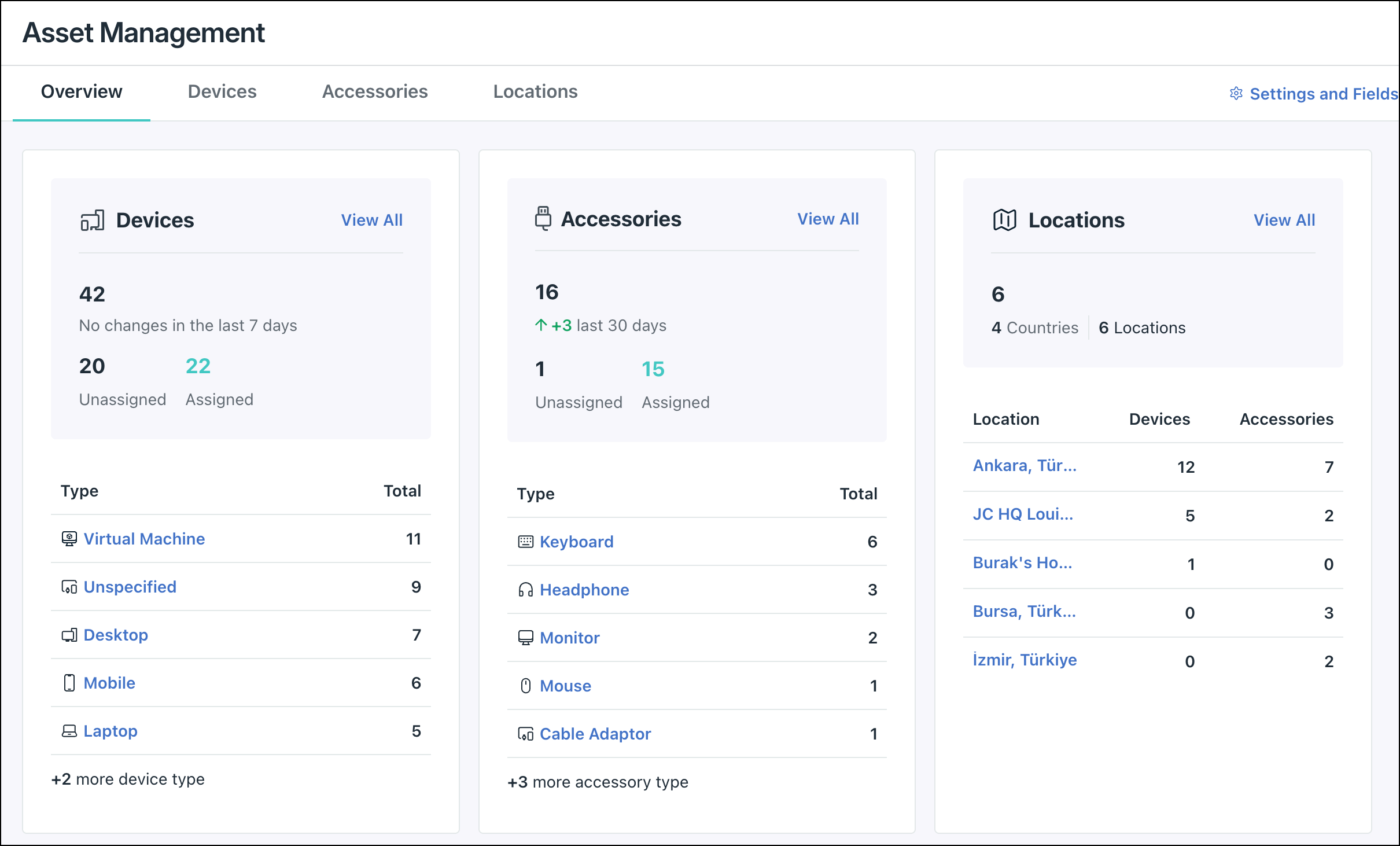
JumpCloud® Asset Management helps you track, manage, and optimize your organization’s IT assets throughout their lifecycle. Asset Management seamlessly integrates with JumpCloud Device Management to track new and existing JumpCloud-managed devices. The JumpCloud Agent automatically discovers connected accessories from your managed devices. You can also manually add unmanaged devices and accessories, such as physical hardware and peripherals. Use locations to manage inventory at various office locations. Asset Management simplifies your existing asset tracking solutions by acting as a central database for all of your IT assets.
Prerequisites:
- JumpCloud Device Management must be enabled in your org and on devices to automatically sync managed devices into Asset Management. See MDM in JumpCloud to learn more.
Considerations:
- Asset Management is a premium feature and requires the Platform Prime package. See JumpCloud Pricing to learn more.
- Devices, Accessories, and Locations are all classified as assets in JumpCloud Asset Management.
- Managed Devices refer to devices that meet the following criteria:
- macOS, Linux, and Windows devices with the JumpCloud Agent installed.
- iOS and iPadOS devices enrolled in Apple Mobile Device Management (MDM).
- Android devices enrolled in Android Enterprise Mobility Management (EMM).
Features
-
Device Management integration: Synchronize with Device Management to automatically add and update managed devices in your asset inventory.
-
Asset creation and management: Track devices automatically synced from JumpCloud Device Management, manually add assets, clone existing assets to quickly duplicate details, or import in bulk using a CSV file. You can also update fields for multiple assets at once.
-
Lifecycle and inventory management: Track assets from acquisition through decommission. Manage quantities, stock levels, and locations of assets. View your Overview Dashboard for key insights.
-
Automated accessory discovery: Automatically detect peripherals—such as monitors, keyboards, docking stations, and headsets—connected to your managed Windows and macOS devices via USB, Bluetooth, and displays using the JumpCloud Agent.
-
Automated warranty management for Lenovo: Automatically retrieve and sync warranty status, coverage dates, and support details for Lenovo devices.
-
Warranty management: Manually record warranty periods and attach invoices directly to asset records under Purchase Details.
-
Physical asset labeling: Generate and print standardized QR codes or barcodes directly from the Admin Portal to identify and track physical hardware.
-
User Portal asset visibility and acknowledgement: Let end users view assets assigned to them directly in the User Portal, including asset name, serial number, status, and ownership type. Request confirmation from the asset owner that an assigned asset was received. Responses are recorded in Asset History, and email notifications keep admins and users informed.
-
Reporting and analytics: Export your asset list to generate reports and insights on asset performance and utilization while ensuring regulatory requirements.
Use the AI Search to quickly generate specific reports. Leverage the AI enhanced search to filter your asset list with a simple search.
FAQ
Start Using Asset Management
See Configure Asset Management to learn how to enable and configure the feature.
Additional Resources
- Enroll: Intro to Asset Management
Was this information helpful?