Create a Device Level macOS Energy Settings Policy
This policy optimizes your energy usage by configuring power-related settings for macOS computers enrolled in Mobile Device Management (MDM).
You can create a schedule that manages energy-saving habits. For example, when inactive devices go into sleep mode, when a laptop computer switches to AC or battery power, or when inactive hard drives spin down. This policy works on devices running macOS 11 and later that are enrolled in MDM. The user cannot change or modify the settings.
This is a device level policy that applies system-wide to the device and all of its users. You can bind this policy to individual devices or device groups. For policies that apply to a specific user's profile across devices, see Get Started: Policies and Learn More section of this article.
Prerequisites
- Apple Mobile Device Management (MDM) must be configured for your organization and Mac computers must be enrolled in JumpCloud MDM. See Set up Apple MDM.
- This policy is supported on Mac computers running macOS 11 and later.
- Devices must have an active network connection for this policy to take effect.
Considerations
- The policy configuration settings are applied automatically and do not require a system restart.
Creating the Policy
To create a Mac Energy Settings policy for Mac computers, do the following:
Selecting the Policy Template
- Log in to the JumpCloud Admin portal.
If your data is stored outside of the US, check which login URL you should be using depending on your region. If your organization uses LDAP, RADIUS, or requires firewall allow list configuration, the Fully Qualified Domain Names (FQDNs) will also be region specific. See JumpCloud Data Centers for the URLs, FQDNs, and IP addresses.
- Go to Device Management > Policy Management. The Policy Management page is displayed.
- On the Policy Management page, click +Add New.
- Select Device Policy to assign the policy to devices and device groups. On the New Device Policy page:
- Select the macOS tab.
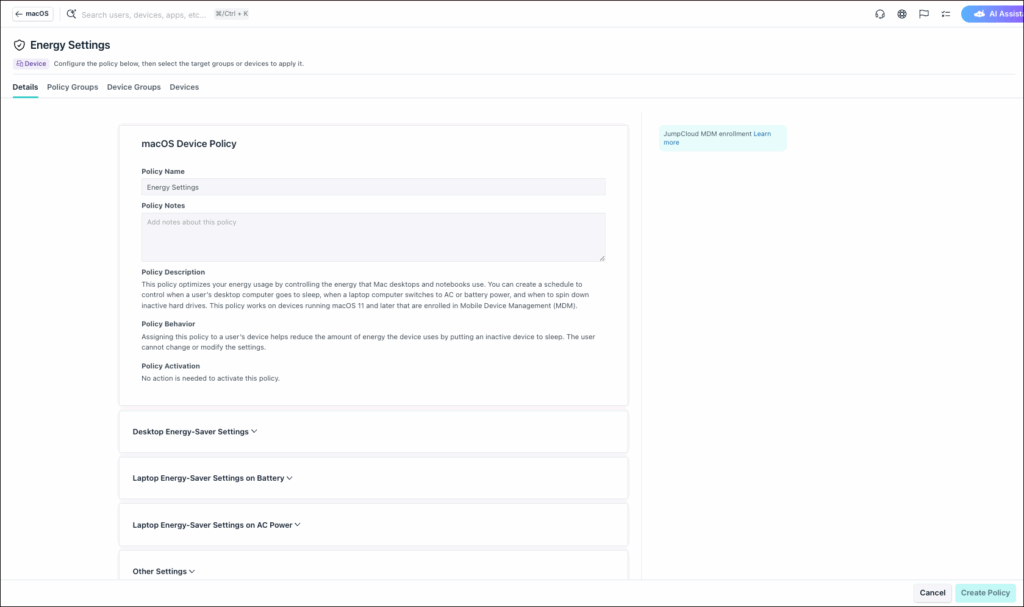
- Search and select the required policy and click Configure. The Details tab of the policy is displayed.
- On the Details tab, configure the required policy configuration settings.
- (Optional) In the Policy Name field, enter a new name for the policy or keep the default. Policy names must be unique.
- (Optional) In the Policy Notes field, enter details such as creation date of the policy, and information on testing and deployment of the policy.
Configuring the Policy
Click to expand the available options under the following settings:
Desktop Energy-Saver Settings
| Field Name | Description |
|---|---|
| Automatic Restart on Power Loss | Automatically restart the desktop when power is restored after a power failure. |
| Disk Sleep Timer | Choose how many minutes of inactivity will occur before the desktop’s hard drive goes to sleep. |
| Display Sleep Timer | Choose how many minutes of inactivity will occur before the desktop’s display is turned off and sleep mode begins. |
| Dynamic Power Step (Desktop) | Select this to let your macOS device automatically balance performance and power savings based on your current activity. |
| Reduce Processor Speed (Desktop) | Select this to prioritize maximum battery life and a cooler-running device over raw processing speed. |
| System Sleep Timer (Desktop) | Select this dropdown to set how many minutes of inactivity should pass before your Mac automatically goes to sleep. |
| Wake on LAN (Desktop) | Select this to allow your computer to wake from sleep for remote file access or network management. |
| Wake on Modem Ring (Desktop) | Select this if your computer needs to wake up when it detects an incoming signal from a connected phone line. |
Laptop Energy-Saver Settings on Battery
| Field Name | Description |
|---|---|
| Automatic Restart on Power Loss | Automatically restart the laptop when power is restored after a power failure. |
| Disk Sleep Timer | Choose how many minutes of inactivity will occur before the laptop’s hard drive goes to sleep. |
| Display Sleep Timer | Choose how many minutes of inactivity will occur before the laptop’s display is turned off and sleep mode begins. |
| Dynamic Power Step (Battery) | Select this to let your Mac automatically balance performance and power savings based on your current activity. |
| Reduce Processor Speed (Battery) | Select this to prioritize maximum battery life and a cooler-running device over raw processing speed. |
| System Sleep Timer (Battery) | Select this dropdown to set how many minutes of inactivity should pass before your Mac automatically goes to sleep. |
| Wake on LAN (Battery) | Select this checkbox to allow your computer to wake from sleep for remote file access or network management. |
| Wake on Modem Ring (Battery) | Select this checkbox if your computer needs to wake up when it detects an incoming signal from a connected phone line. |
Laptop Energy-Saver Settings on AC Power
| Field Name | Description |
|---|---|
| Automatic Restart on Power Loss | Automatically restart the laptop when power is restored after a power failure. |
| Disk Sleep Timer | Choose how many minutes of inactivity will occur before the laptop’s hard drive goes to sleep. |
| Display Sleep Timer | Choose how many minutes of inactivity will occur before the laptop’s display is turned off and sleep mode begins. |
| Dynamic Power Step (AC Power) | Select this to let your Mac automatically balance performance and power savings based on your current activity. |
| Reduce Processor Speed (AC Power) | Select this to prioritize maximum battery life and a cooler-running device over raw processing speed. |
| System Sleep Timer (AC Power) | Select this dropdown to set how many minutes of inactivity should pass before your Mac automatically goes to sleep. |
| Wake on LAN (AC Power) | Select this to allow your computer to wake from sleep for remote file access or network management. |
| Wake on Modem Ring (AC Power) | Select this if your computer needs to wake up when it detects an incoming signal from a connected phone line. |
Other Settings
| Field Name | Description |
|---|---|
| Destroy FileVault Key on Standby | Prevents the device from storing a temporary FileVault key in the System Management Controller or RAM when the device is on standby. |
| Sleep Disabled | Prevents the device from going to sleep. |
Schedule
| Field Name | Description |
|---|---|
| Repeating Power Off Time | Set your preferred shut-down time by entering the number of minutes past midnight (e.g., 1320 for 10:00 PM). |
| Repeating Power Off Weekdays | Select the specific days of the week you want your device to automatically power down or go to sleep. |
| Repeating Power Off Event Type | Choose the end-of-day action: have your device fully shut down, restart, or enter sleep mode to save energy. |
| Repeating Power On Time | Set the exact time you want your Mac to automatically start up or wake. Enter the time in minutes past midnight (for example, enter 420 for 7:00 AM or 1080 for 6:00 PM). |
| Repeating Power On Weekdays | Choose which days of the week you want this schedule to run. You can select individual days, weekdays, weekends, or every day to ensure your device is ready exactly when you start your routine. |
| Repeating Power On Event Type | Choose whether the device should fully power on, wake from sleep, or both to ensure it is ready for use. |
Applying the Policy
- (Optional) Select the Policy Groups tab. Select one or more policy groups where you want to add this policy.
- Select the Device Groups tab. Select one or more device groups where you want to apply this policy. For device groups with multiple OS member types, the policy only applies when a user logs into a supported Mac computer that is enrolled in Apple MDM.
- Or, select the Devices tab. Select one or more devices whom you want to add this policy to.
- Click Create Policy. A success message is displayed indicating the completion of policy creation.
Viewing Policy Status
- Select the Statustab.
- To see the last Result Log for a device where this policy is applied, click view.
- If any errors occur, they're listed inExit Status. If you have an Exit Status of 0, no errors occurred when applying or enforcing this policy.
Was this information helpful?