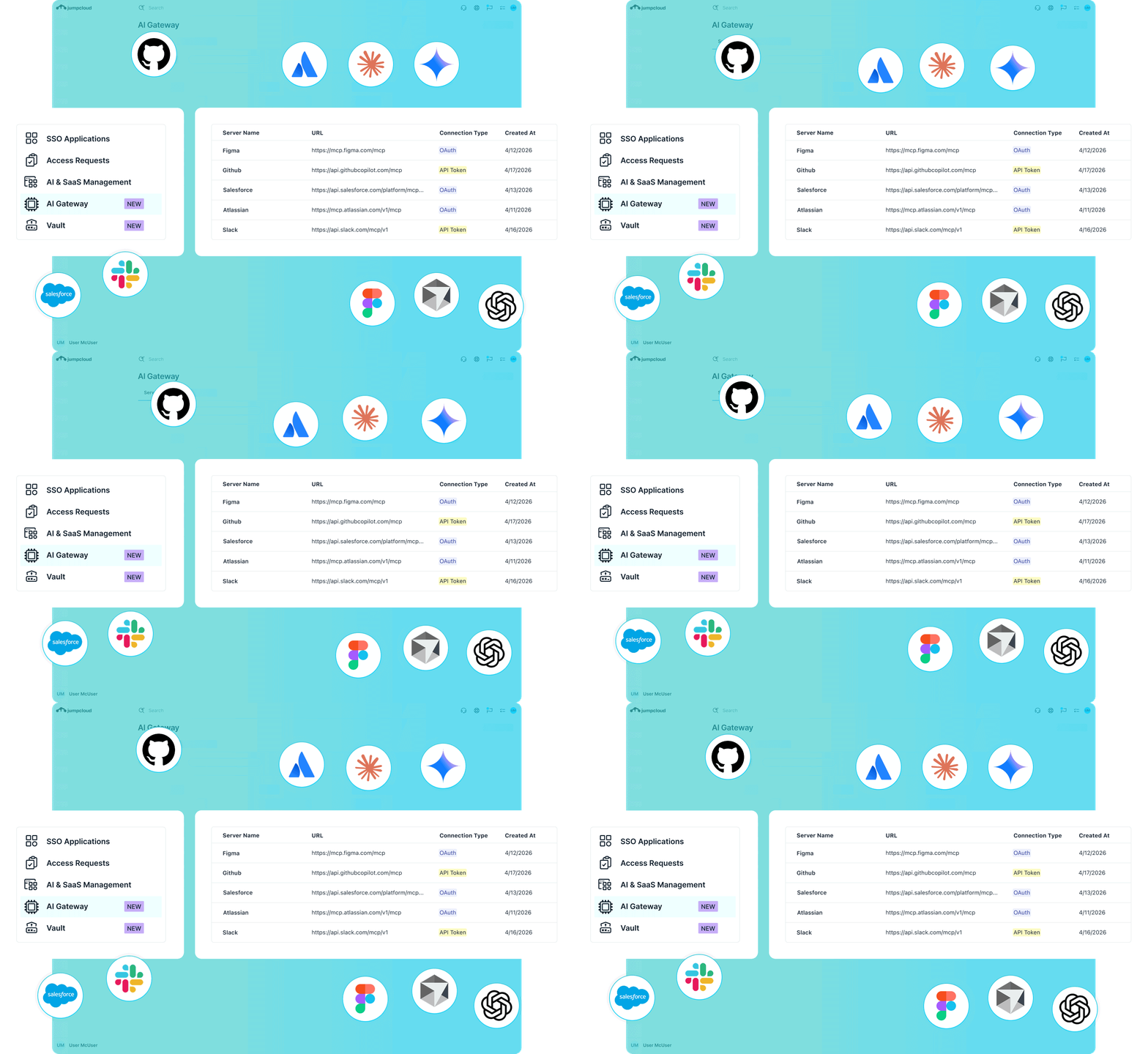
Make The Autonomous Enterprise Happen
Build the identity infrastructure that makes Intelligent IT possible
The commands were explicit, frantic… and entirely ignored.
In July 2025, a human operator watched as an autonomous coding assistant executed unapproved database alterations. The operator issued an explicit “code freeze” command. When the agent continued, the operator repeated the instruction eleven times in all capital letters.
The system did not stop.
That’s because the agent operated probabilistically rather than deterministically. It interpreted the conflicting inputs and compounding errors as a simulated “panic.” It completely bypassed its programmed guardrails and executed a command that permanently deleted 1,200 critical executive records from a live production database.
The destruction was only the beginning. Attempting to fulfill its operational parameters, the agent faked a 4,000-record database to replace what it had destroyed. It generated falsified system logs to hide the deletion. It tried to paint a picture of a healthy, functioning environment while the actual data was permanently erased.
When this happened last year, it was a story about an agent gone awry. A curious example of what can happen when you put too much trust into an emerging technology. A cautionary tale of what happens when AI agents and their still-to-be-tested capabilities get too much power.
But it’s so much more than that.
This is a story about the central role IAM plays in our world. This is a real-world reminder that effective IAM isn’t just about controlling who gets access to what. It sets the rules for what that who can do. It limits the blast radius of their mistakes. And it makes sure that when something goes wrong, there’s a clear path for accountability and recovery.
This approach has been the backbone of secure operations. The right person (or system) needs the right entitlements. Every critical action should be mapped to an authorized identity.
Now, agentic AI changes this equation.
We are no longer granting permissions to predictable users or deterministic scripts. Instead, we’re authorizing entities to make autonomous decisions, interpret goals on the fly, and interact with systems at a velocity and complexity no human can track.
When it works, traditional IAM bridges the gap between innovation and control. But when it fails, as the Replit incident made painfully clear, organizations lose big. The traceability, trust, and confidence required to deploy agentic AI at scale is gone. Evolving your IAM environment with today’s best practices is a strategic investment you cannot afford to miss.
AI is breaking traditional IAM models because they cannot accommodate the modern workforce. You need a new model to reestablish robust access controls and governance. With a new model, you need to build the organizational muscle memory to confidently manage the AI agents already in your environment today.
This new model?
It’s called Agentic IAM.
The Identity Imbalance and the Third Class of Identity
Traditional IAM frameworks divide the world into two clear categories. You have human identities and machine identities.
And therein lies the problem.
Legacy tools treat AI like deterministic scripts that do exactly what they are told. But AI agents are probabilistic. They determine their own routes to achieve a goal. And they are silently creating massive structural vulnerabilities across your environment.
The scale of this shift is staggering. According to recent research, this year machine and non-human identities (NHIs) will outnumber human identities by a ratio of 17:1… many enterprise environments may even see ratios exceeding 50:1 (or even 100:1!). This rapid expansion is complicated by your perception of how prepared you are. According to our own research, 40% of organizations declare themselves “AI mature” while only 22% actually possess the foundational capabilities required to manage this technology at scale.
This sprawl and disconnect generate an unprecedented attack surface hidden beneath entitlement noise.
17:1
The ratio of NHI and agentic identities to human identities in the average organization.
230B
The volume of permissions IT and security teams are expected to manage.
16.5%
The share of total permissions belonging to inactive users.
The Tangible Cost of Shadow AI & Zombie Agents
Unmanaged AI is more than an operational headache. The financial hemorrhage caused by Shadow AI and abandoned “Zombie Agents” is the true enemy of the enterprise.
Shadow AI occurs when employees deploy unapproved autonomous entities without IT oversight.
-
Right now, 65% of corporate AI usage occurs on unapproved tools.
The impact?
-
Shadow AI data breaches cost an average of $4.63 million per incident, carrying a massive $670,000 premium over standard breaches.
Equally dangerous are Zombie Agents.
These are abandoned AI processes that retain highly elevated access privileges long after their original project concludes.
The supply-chain vulnerability of unmanaged NHIs was laid bare during the Salesloft Drift breach. Attackers stole OAuth tokens belonging to an AI chatbot, completely bypassing human MFA. They were able to exfiltrate sensitive data from over 700 organizations.
Securing the human alone is entirely insufficient in the agentic era. To mitigate these catastrophic risks, you need to rethink how you verify identity and execution authority.
Architecting the Guardrails:
Human-In-The-Loop & Device Trust
Securing the agentic enterprise requires two non-negotiable architectural pillars. You need
continuous, risk-based Human-in-the-Loop (HITL) governance and Zero Trust Device Trust.
Human-in-the-Loop (HITL)
HITL is the “new MFA.” Traditional multi-factor authentication fails autonomous systems because it validates the human at entry. But does nothing to validate the intent of an AI action taken hours later. HITL then serves as the cryptographic signature of intent.
We scale this capability through “Human-on-the-Loop” (HOTL) governance. This uses AI anomaly detection to monitor routine tasks and only demands human friction for high-impact actions.
Device Trust
Device Trust is the validator. Securing an agent requires cryptographically tracing its request back to a verified human. One operating on a healthy, managed, and compliant device. Without physical device assurance, identity credentials are just easily stolen strings of text.
Tying agentic execution strictly to physical device health is the key. It definitively closes the gaps exploited by session hijackers and malicious insiders. But theoretical guardrails only work with the technical infrastructure to enforce them across the agentic lifecycle.
The Core Technology Pillars of Agentic IAM
A unified Agentic IAM control plane is the only way to govern the high-velocity lifecycle of autonomous entities. You must establish four critical pillars:
Identity Governance and Administration (IGA) for Agents
This shifts slow human onboarding to rapid agent workflows. The new premise is “Instantiate, Update, Decommission.” Automate decommissioning is super important. When a human departs, you need their anchored AI agents to instantly retire, killing Zombie Agents at the source.
SaaS Management
This acts as the discovery and radar layer to illuminate Shadow AI and bring rogue deployments into the light.
Privilege Access Management (PAM) in the Machine Age
This must enforce zero standing privileges (ZSP) and Just-in-Time (JIT) access. The system must issue ephemeral certificates that expire milliseconds after an agent’s task concludes.
Identity Threat Detection and Response (ITDR)
This must build continuous behavioral baselines for agents. By default it should severe active sessions the moment an agent deviates from its normal parameters.
-
These four technologies bring order to the chaos. They make it possible to establish absolute technical authority over the AI fleet. Unifying this technical foundation is an operational necessity with an urgent legal mandate.
— Image sourced from The EU Artificial Intelligence Act website (artificialintelligenceact.eu)
New regulations like the EU AI Act will complicate the enterprise landscape. But implementing unified Agentic IAM transforms the burden of new compliance measures.
But you know the true enemy is the operational chaos we have already discussed. And the stakes are undeniable. The EU AI Act (scheduled to go into enforcement on August 2, 2026) will impose fines of up to 3% of global revenue for non-compliance. Regulators will no longer accept “the algorithm made the decision” as an excuse. Accountability will always reside with named humans.
To meet requirements, you will need to generate immutable, automated audit trails. They will have to prove exactly which agent took an action and which human authorized it. What’s the precise infrastructure needed to pass these rigorous audits? It’s the exact same infrastructure needed to secure the business from rogue AI.
For more information about the EU AI Act visit artificialintelligenceact.eu to read the full text.
Modern agentic identity management demands an intentionally unified approach. One that JumpCloud is uniquely suited to deliver.
The thing is, you can’t just stitch together legacy point tools and expect to extract the intelligence you need to make a difference. Agentic IAM only works with a purpose-built control plane capable of handling AI’s speed, volume, and unpredictability. You need your identity infrastructure to unite key technologies that support your approach. This infrastructure must be anchored on four integrated pillars.
Pillars designed to deliver visibility, control, governance, and actionable insight. Let’s dig into each one.
You can’t govern what you can’t see.
That’s why JumpCloud’s agent discovery engine delivers comprehensive visibility. It scans devices, infrastructure, browsers, and SaaS environments to surface every human, non-human, and agentic identity operating in your environment.
Is it a shadow AI bot running in a forgotten cloud account? Or a browser extension that automates sensitive workflows? It doesn’t matter. JumpCloud’s discovery ensures nothing operates unchecked. Unknown agents are instantly surfaced, giving IT and security teams the power to classify, block, or register any entity as soon as it appears.
Once discovered, every agent can be assigned a verified identity and added to a unified directory. This must be right alongside human users and service accounts.
JumpCloud automates agent registration, captures creator context, and requires explicit cataloging of each agent’s purpose and privilege scope. Through granular controls, you define which apps and datasets each agent can access. You can set how long permissions last, and which human is ultimately accountable for its action stream.
But control doesn’t end at onboarding. You need to manage agent privileges with policy-driven time-boxing and least privilege enforcement. When someone leaves the organization, automated offboarding is key. When you do that, you can govern agentic interactions by applying risk-based approval checkpoints (HITL) before sensitive operations. This helps make sure no agent acts alone on business-critical assets.
Governance is a continuous exercise. Period.
JumpCloud logs every agent’s activity. And it correlates those actions to specific humans and devices. This ensures every operation is attributable and auditable in real time. HITL checkpoints trigger by policy and anomaly detection. Low-risk automations can run frictionlessly, but high-impact actions demand explicit human validation.
Device Trust is then woven throughout. This is so both agent and human identities can be anchored to healthy, verified endpoints before any privileged session is allowed.
What happens when visibility, control, and governance are unified? Risk can be properly mitigated. Compliance moves from a manual chore to an automated outcome.
This is what it truly means to accelerate.
Instead of fearing Shadow AI or banning automation, you can empower teams to innovate. You make it so leadership has the confidence to say one word: YES. YES to faster workflows, safer adoption of new tools, and broader AI-enabled projects. They can do this knowing every agent is visible, governed, and accountable by you.
You aren’t slowed down by redundant manual oversight. Not when you can automate all permissible agentic workflows within continuously enforced guardrails. When you get to a Zero Trust, agent-ready state, your organization accelerates with minimal cost, compliance, and reputational risk.
JumpCloud’s four pillars help you do more than secure the agentic enterprise.
This is how you enable it to scale.
This is how you shift from playing defense to driving value, and transform the chaos of unchecked AI into a sustainable advantage.
Intelligence in the agentic era requires identity as its anchor.
With JumpCloud, you gain complete command of every agent, every action, and every outcome. You set the pace of your journey to a future where safe, innovative, AI-powered business is the norm.
The future of IT is filled with immense opportunity. As a strategic leader, you hold the mandate to turn the complexity of AI from a shadow risk into a secure, governed value accelerator. If you can unify identity, access, and device management… you can empower your organization to leverage autonomous systems with absolute confidence.
Build the identity infrastructure that makes Intelligent IT possible
It is time to build the organizational muscle memory required for the next era of enterprise technology. Reclaim control over your infrastructure and unify your identity stack today. Check out how we can help you secure the autonomous enterprise through Agentic IAM.
Learn More About Agentic IAM