Connect


Let’s admit something uncomfortable: your team is currently paying a hidden tax. Every time an IT admin manually provisions an account, a security team member hunts through fragmented logs to patch a compliance hole, or a support ticket sits in limbo, it is your organization that pays the price.
The status quo is officially broken. We’ve been told that piecing together disjointed tools with custom scripts and sheer willpower is just “the cost of doing business.” It’s not.
It’s an operational crisis.
The Reality of Modern IT Friction
When you look closely at today’s organizations, the cracks in the foundation are hard to ignore. They usually manifest in four distinct, compounding problems:
1. Chronic Operational Efficiency Gaps
Fragmented manual processes create severe productivity bottlenecks and widespread frustration. This isn’t just about IT admins being buried under a mountain of repetitive administrative tasks; it directly degrades the end-user experience. While your high-value IT talent is trapped in a cycle of manual interventions, users are left waiting for hours or even days just to get the access and support they need to do their jobs.
2. Dangerous Security Blind Spots & Compliance Risks
When data lives in silos, visibility dies. Fragmented processes inevitably lead to privilege creep, where users or autonomous agents retain access to systems they no longer need. When a security anomaly occurs, teams are unable to quickly pinpoint the threat. This visibility gap transforms what should be a swift containment into a manual fire drill, both for urgent threat mitigation and for proving who had access to what during compliance audits.
3. Systemic Risk Built on Brittle Custom Code
Relying on legacy manual processes or custom-coded scripts to handle Joiners, Movers, and Leavers is an accident waiting to happen. If the admin who built those custom scripts leaves the company, that knowledge leaves with them. The remaining team is left to manage a broken black box. This lack of centralized automation delays new-hire productivity, accelerates privilege creep during internal role changes, and turns off-boarding into a guessing game of whether an ex-employee still has access to company data.
4. Disconnected Identity, Devices, and Access Tools
Most automation tools suffer from tunnel vision. They usually only work within their own ecosystem. To get them to trigger actions in external systems, you have to step in and do it manually.
As your organization scales, this disconnection creates massive bottlenecks. Because your access management is totally isolated from critical daily tools like your HRIS, Slack, and ticketing systems, IT cannot automatically connect users to the resources they need.
The result? A disjointed, error-prone environment that simply cannot keep pace with the demands of a modern workforce.
The Real Culprit: Great Tools, Zero Communication
The core of the problem comes down to a simple contradiction: companies buy the absolute best software available like Salesforce, Jira, Slack, and Workday, but none of these tools actually talk to each other.
Because they operate in isolated silos, manual effort becomes the glue holding your entire tech stack together. But manual work leaves no digital footprint. It is a massive compliance risk. Without centralized tracking, you face potential legal headaches and heavy fines from regulatory failures like SOC2, GDPR, or HIPAA. When audit season arrives, your security team wastes expensive, billable hours digging backward through systems just to manually collect evidence.
Unified IT Orchestration via JumpCloud
To break free from this cycle, we need to stop thinking about identity, devices, and workflows as separate disciplines. They are deeply interconnected parts of a single operational lifecycle.
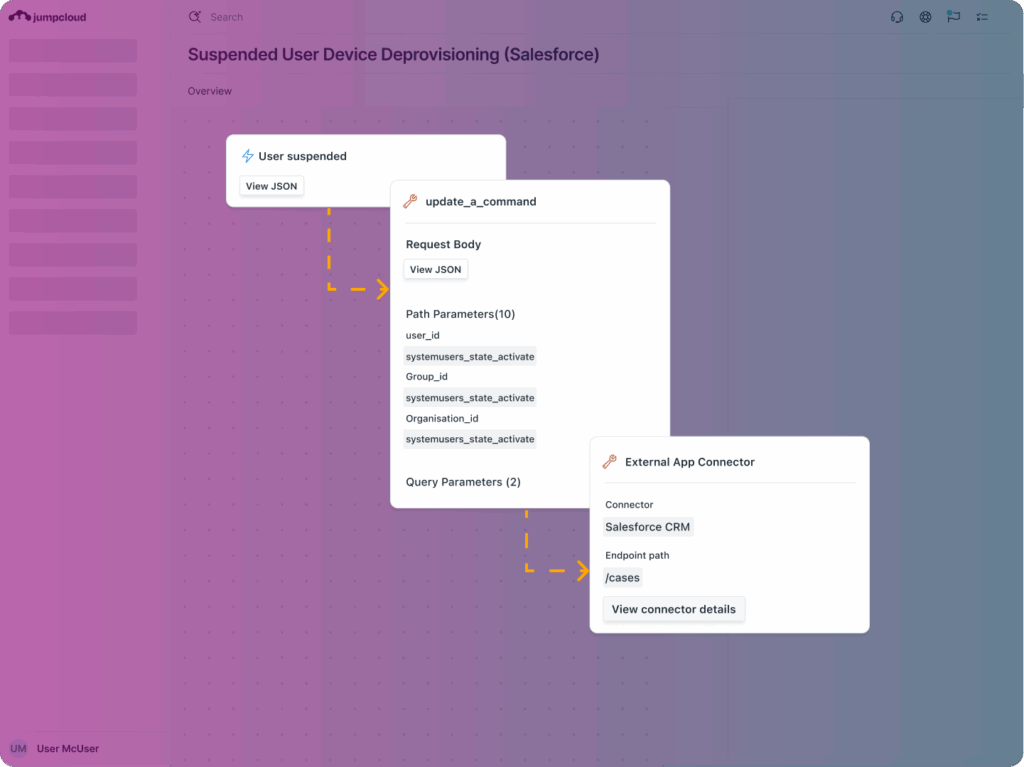
JumpCloud Workflows is a powerful, no-code automation engine built directly into JumpCloud. It extends your platform to any system, with no scripting required.
Key Features:
- No-Code Visual Builder: A canvas-based visual interface using modular nodes for triggers, logic, and actions, with dynamic variables for easy data mapping.
- Multi-Trigger Engine: Triggers workflows automatically via system events, schedules, manual actions, rules, or external signals.
- Advanced Operations and Logic: Incorporates conditional pathways into workflows such as If/Else, switches, loops, retries, and forks.
- Cross-System Actions: Executes tasks within JumpCloud while triggering external actions, emails, and notifications like Slack.
- Pre-Built Workflow Templates: A library of 10-20 predefined templates for common JumpCloud IT use cases.
- Workflow Testing / Mock Runs: Allows admins to run their drafted workflow using mock data before making the automation live.
- Execution History and Logging: Logs DI events for workflow operations and provides a list view of runs with color-coded status badges.
- Centralized Management Console: A dedicated UI section to view, manage, execute, and build all workflows in a single location.
Key Benefits:
- Replaces complex scripting with code-free, readable visual flows, ensuring logic accuracy and reducing configuration errors.
- Offers full flexibility to launch automations via system events, scheduled cadences, or third-party alerts.
- Enables IT teams to build precise, cross-system orchestration sequences for complex routing and decision-making.
- Connects external apps beyond JumpCloud to seamlessly control the full identity and device lifecycle.
- Offers easy starting points for common use cases, ensuring workflow logic is clear and well-understood.
- Safely validates automation logic and behavior before deploying to production.
- Reduces troubleshooting effort with quick failure identification, root-cause analysis, and continuous compliance auditing.
- Provides a single pane of glass for all IT automation, increasing efficiency and scaling without administrative debt.
Stop Tolerating the Friction
Continuing to rely on manual workflows and disconnected tools is a choice – One that costs your organization time, money, and security integrity every single day. The status quo is a luxury you can no longer afford. It’s time to reclaim your team’s productivity, secure your environment, and eliminate the automation tax for good.
Ready to see JumpCloud Workflows in action?